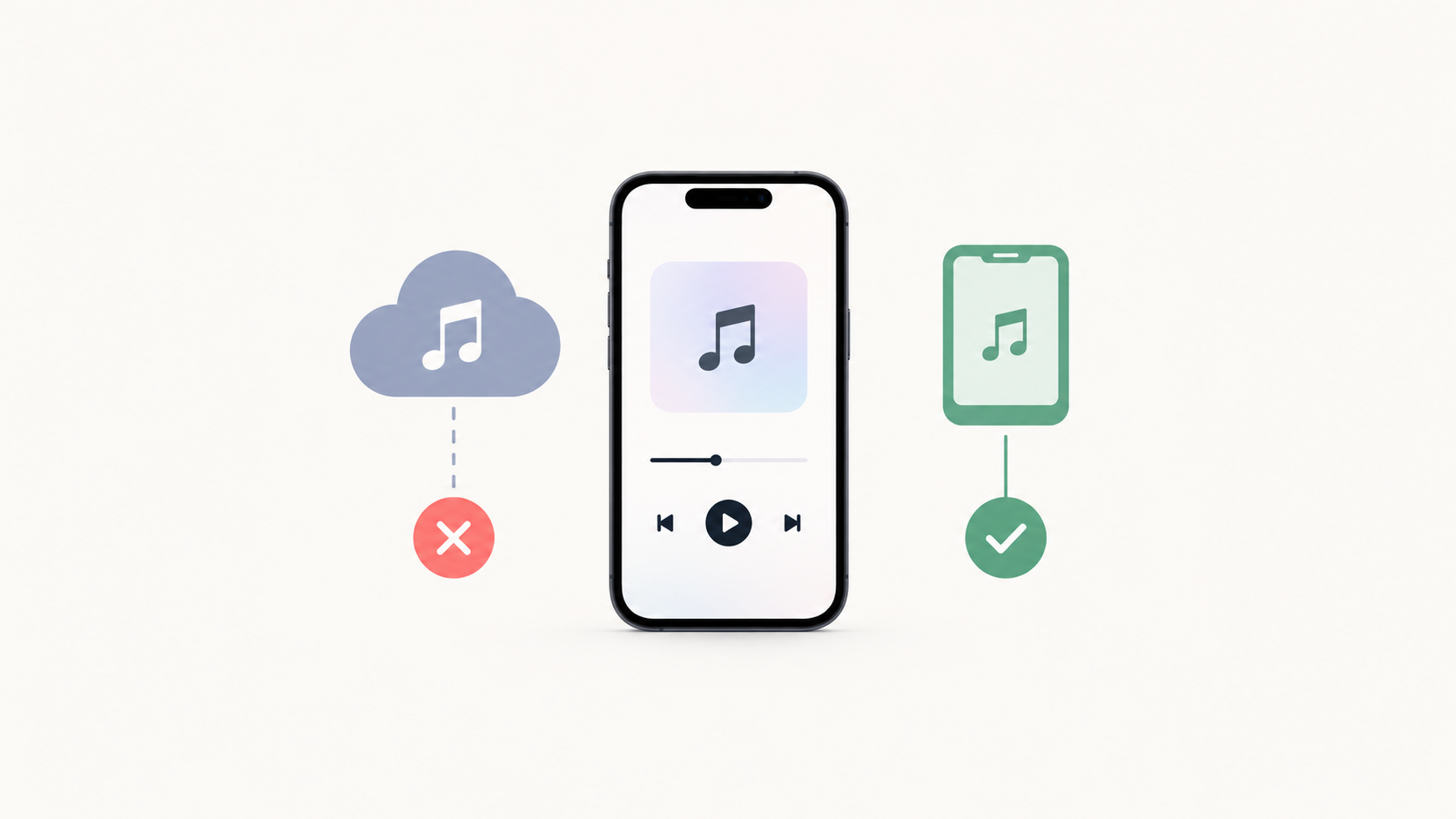
If you cancel your subscription, what happens to your music depends entirely on how the app stores your files. Cloud-based, streaming-only AI music tools typically cut off access to your library the moment your subscription lapses — the songs may still exist on a server somewhere, but you can no longer play, download, or move them. Tools that save files locally to your device work differently: those songs are already yours, sitting on your phone as standalone files, and they keep playing whether or not you're still paying. The rest of this comes down to understanding which model a given tool uses — and what that actually means for you day to day.
Why this question matters more than it seems
This is one of the most practical fears anyone has before subscribing to an AI music generator. You're not just paying for access to a tool — you're building something. A library of tracks, maybe dozens of them, made over weeks or months. So the question isn't abstract: if you stop paying, do you lose all of it? Does the app hold your work hostage to keep you subscribed?
It's a fair thing to worry about, because the answer genuinely varies across AI music tools — and most of them don't explain it clearly until you've already hit the wall.
Two different architectures, two different outcomes
Broadly, AI music generators fall into two camps based on where your finished songs actually live.
Cloud/streaming-based tools generate your song and store it on their servers. You access it through the app, streaming it back each time you want to listen. This works fine as long as you're subscribed — but the moment your subscription ends, that access typically ends too. The file isn't sitting on your device; it's sitting on someone else's infrastructure, gated behind your account status. Cancel, and the door closes. Your music may technically still exist somewhere, but you can't get to it, move it, or use it anywhere else.
Locally stored / on-device tools work the opposite way. When you generate a song, the file is saved directly onto your phone as a standalone file — not a stream, not a server reference, an actual file you possess. Once it's there, it's there. It plays with or without an active subscription, because playback doesn't depend on a live connection to anything. You can move it, share it, back it up, or drop it into another app, because it behaves like any other file on your device.
The honest trade-offs — because neither model is "free" of downsides
It's worth being straightforward about what each approach actually costs you, because there's no version of this that comes with zero trade-offs.
Cloud/streaming libraries offer things local storage doesn't: automatic backup, access from multiple devices without manual transfer, and no risk of losing everything if your phone is lost, damaged, or reset. The cost is that your access is conditional — tied to your subscription, tied to the platform staying operational, tied to their servers staying up. If any of those breaks, so does your access.
Locally stored files flip that trade-off. Because the song lives on your device, it survives a lapsed subscription — you don't lose what you've already made just because you stopped paying this month. But local files aren't automatically cloud-backed. If you lose your phone, or wipe it without backing up first, those files go with it unless you've moved or backed them up yourself. Portability and independence come with the responsibility of managing your own files, the same way you would with photos or downloaded music.
There's also a nuance worth being precise about: local storage means the files persist on your device, but that's distinct from the app itself. If you delete the app, you may lose the ability to access or manage those files through the app — the files being on your device isn't the same as the app functioning as a permanent archive. The honest way to think about it is that local storage buys you portability and independence from your subscription status, not a guarantee that nothing can ever go wrong with the file.
Where Melogen fits into this
Melogen is built on the local-storage model. Every song you generate — instrumental or with lyrics — saves directly to your device as a standalone file the moment it's created. There's no account, no login, and no cloud sync involved in that process; the file is simply on your phone.
Practically, that means if you cancel your Melogen subscription, the songs you've already generated keep playing. They don't disappear, get locked, or require a renewed subscription to access — because access was never tied to a live connection in the first place. You can move those files, share them, or use them elsewhere, the same as any file on your device.
What this doesn't mean is that Melogen functions as permanent cloud backup — it doesn't store copies on servers for you to redownload if your device is lost or wiped. The files are yours to keep in the sense that they're genuinely on your device and independent of your subscription — not in the sense that they're backed up somewhere safe forever, no matter what happens to your phone.
How to think about this before you subscribe to any AI music tool
If you're evaluating any AI music generator — Melogen or otherwise — this is a question worth asking directly before you commit: if I stop paying, do I keep what I've made? The answer tells you a lot about the underlying architecture and what you're actually trading your subscription for.
A few practical questions to ask:
- Does the app generate a file, or a stream? (Streams typically require an active connection and subscription to access; files don't.)
- Is that file stored on your device, or only on the company's servers?
- If you cancel, can you still open and play what you already made?
- If you delete the app, does that affect your access to files already saved elsewhere on your device?
None of these questions require you to understand the technical architecture in depth — they just require the app to be upfront about where your songs actually live. Tools that store files locally can usually answer these plainly, because the mechanism is simple: the song is a file, and files stay where you put them.
The bottom line
Whether canceling a subscription costs you your music library comes down to one structural question: is your song a file on your device, or an entry in someone else's database? Cloud/streaming tools tend to gate access behind an active subscription, because the file lives on their infrastructure, not yours. Locally stored tools, like Melogen, save the file to your device at the moment of creation — so it keeps playing regardless of your subscription status, though it's still on you to back it up if you want protection against losing the device itself.
Neither model is inherently better in every respect — it's a genuine trade-off between convenience/backup and independence/portability. But if the fear driving your hesitation is specifically "will I lose everything if I stop paying," the answer depends entirely on whether the tool you're using stores files locally or keeps them behind a subscription wall. Know which one you're using, and you'll know exactly what happens the day you decide to cancel.